Why Omni over Hex?
Hex was built for data teams working in notebooks. Omni was founded on governed data everyone can use.
AI answers everyone can inspect, not just accept: Omni's AI queries your semantic layer – the same governed metrics, joins, and business logic behind your dashboards – so every answer is consistent and auditable from the UI. Hex now supports semantic models, but its AI generates SQL and Python alongside that layer, not through it. When an answer looks off, there's no governed model to trace it back to or a way for stakeholders to investigate and validate.
Pick up where AI left off: In Omni, when AI surfaces an insight, anyone can keep going. Switch to spreadsheets, Excel formulas, SQL, or point-and-click — all in the same workbook, without losing context. This allows all users to validate responses and explore further. In Hex, business users get Threads. Data teams get notebooks. The two audiences work in different interfaces with different capabilities. When a follow-up goes beyond what the agent produces, it routes back to the data team, creating a bottleneck.
A governed foundation that grows with your team: Omni's built-in semantic layer keeps metrics consistent across every user and workflow. Users can build measures during exploration and promote reusable logic to the shared model, so AI context compounds and improves results for everyone.
Enterprise governance: Manage row and column-level security, role-based access, SSO and SCIM, and content approval workflows natively in Omni. Hex lacks native row-level or column-level security, leaving governance gaps that add risk and friction at scale.
Develop analytics the way you ship code: Roll out AI and analytics confidently with branch mode, Git integration, content validation, and a two-way dbt integration that lets you push changes back – not just sync one way. Hex syncs from dbt Cloud but cannot push updates back, slowing iteration for teams that rely on governed models.
Omni's AI isn't a black box. We're able to learn from our own usage and take action. We still have control — and that's crucial to ensure AI is trustworthy for users across our organization.- Priya Gupta, Head of Data

Built trustworthy AI context with Omni and dbt to scale self-service analytics across the organization
Read case studyHow Omni & Hex compare
Omni's AI is built on a governed foundation to help every user trust the results and dig deeper.
Omni's AI queries your semantic layer, so every user gets governed, consistent answers. Hex's AI generates SQL and Python on the fly for each query, which non-technical users can't validate on their own.
Omni's AI answers questions reliably by generating semantic queries through your governed data model, not raw code. It plans a query, executes it, validates results, and iterates. It handles multi-step reasoning, topic switching, and complex questions grounded in your business context — and it's included for every customer.
Hex's AI generates raw SQL and Python, with optional support for a semantic layer bolted on. Lacking foundational guardrails, reliability depends on how well the agent interprets what it finds, rather than being governed from the start.
When AI surfaces an insight, Omni lets you keep going. Continue the conversation, or switch to spreadsheets, Excel formulas, SQL, or point-and-click analysis, all in the same workflow, without losing context. AI and all other analysis modes are fully interoperable.
When users want to go beyond AI, Hex has fewer options. There's no spreadsheet with Excel-style formulas and no unified workbook where AI results, dashboards, and manual analysis coexist. When a follow-up goes beyond what the agent produces, it routes back to the data team.
Our big lesson with AI is that it's about control. When you constrain it and give it context, like Omni's semantic layer does, you get predictable, reliable results that drive action. Without Omni's AI summaries, some of our biggest operational gains would have been harder to achieve.
– Edward Mancey, Director of Data at Synthesia (read the case study)...I've had lots of issues where I will explicitly tell the AI where the data is located, and it still takes like 4 or 5 tries to actually find the data, the data model helps a lot with this, but it doesn't solve the underlying issue, and in-fact has made it worse in some scenarios…
– Hex customerOmni lets you tune AI with business context directly in the model. Curate Topics, add AI context and synonyms to any field, and define reusable agent skills that package multi-step analysis into one-click actions. Build a skill once, and every user gets the same governed result.
Hex has no equivalent to model-defined agent skills. Context Studio provides endorsements, guides, and monitoring. But repeatable analyses require pre-built notebooks or apps, which are heavier to create and maintain.
A unified AI experience, grounded in one governed model, available across every surface and external tool. Omni's AI works everywhere you do: in AI chat, on dashboards, inside workbooks, in the model, via MCP server (Claude, ChatGPT, Cursor, VS Code, Codex), or programmatically via API.
Hex's AI lives in separate interfaces with separate capabilities. Business users get Threads. Data teams get the Notebook Agent. When a question outgrows one method, it escalates to the other.
...now I can just open up [Omni's agent] and ask exactly what I'm looking for — like 'Who were our top suppliers last month based on GMV growth?' The level of detail is excellent, and honestly, it's actually fun to use.
– Sophie Paulin, Chief Marketing Officer at Ordermentum (read the case study)It can be slow at times, and the interface and information architecture feel a bit complex to navigate, especially when I'm trying to figure out when to use projects versus threads versus explorations.
– Hex customerChoosing Omni is solving for more than just BI. We've also primed ourselves to leap forward into AI because the semantic model is at the heart of the platform. That's not true for many other tools.- Mike Doll, VP of Data

Gave thousands of users governed data access while scaling AI-powered insights across the organization
Read case studyOmni is built for your whole organization, not just the data team.
Hex started as a notebook platform for data scientists and analysts. It now includes self-serve features on top of a SQL- and Python-first foundation. Omni was built from the ground up for governed self-service, with a semantic layer that gives every user, technical or not, a consistent, trustworthy way to explore data.
Omni's built-in semantic layer ensures consistent metrics across every user, every tool, and every AI response. Define metrics, curate trusted datasets, manage joins, and configure aggregate awareness for sub-second responses on pre-computed roll-up tables. No external metric store required.
Hex's semantic layer is newer and narrower in scope. It can sync models from dbt, Snowflake, or Cube, but native authoring lacks support for extensions, aggregate awareness, user attribute integration, and complex join topologies.
Anyone can move fast with Omni. Business users get interactive dashboards with cross-filtering, drill-throughs, period-over-period comparisons, and KPI visualizations out of the box. Users can ask Omni's agent follow-up questions from dashboards, and pivot to a workbook with Excel-style formulas, SQL, or point-and-click exploration without losing context.
Hex's UI was designed for technical users first, and the self-service experience reflects that. Threads and the Explore UI give business users a way in, but without a spreadsheet layer or unified workbook, there's a ceiling on how far they can go without looping in the data team.
Omni gives us the very sweet spot between providing good governance for the data team to maintain some order within metrics, but also enough flexibility to allow ad hoc versions for users.
– Omni customerWhile it succeeds as a notebook tool, the BI part could be better.
– Hex customerOmni offers spreadsheets powered by live data — a familiar Excel-like interface with formulas, forecasting, and rich formatting. All running on governed data inside the same workbook as your dashboards, SQL, and AI.
Hex offers no-code cells and an Explore UI, but there's no unified spreadsheet experience. Pivot tables, filters, and calculations live in separate notebook cells, an interface designed for data scientists.
Just-in-time data modeling lets you build as you go. Users can add or update shared definitions during analysis, then promote reusable logic to the shared model. The semantic layer evolves through everyday work, not top-down mandates. With Omni, context compounds with every query.
Hex keeps exploration and modeling as separate workflows. Insights generated in Threads or notebooks do not feed back into a governed semantic layer. They create standalone projects that the data team has to manually review and maintain.
Omni's intelligent caching delivers fast, fresh results by leveraging the full power of your underlying data warehouse investment. Pre-computed roll-up tables and aggregate awareness keep dashboards responsive as data scales. Warehouse costs stay predictable as usage grows.
Hex relies on managed kernels for query execution, adding overhead that can degrade performance at scale without fully leveraging your data warehouse investment. There's no semantic caching, aggregate awareness, or pre-computed roll-ups. As query complexity and user count grow, most unique queries still hit the warehouse directly.
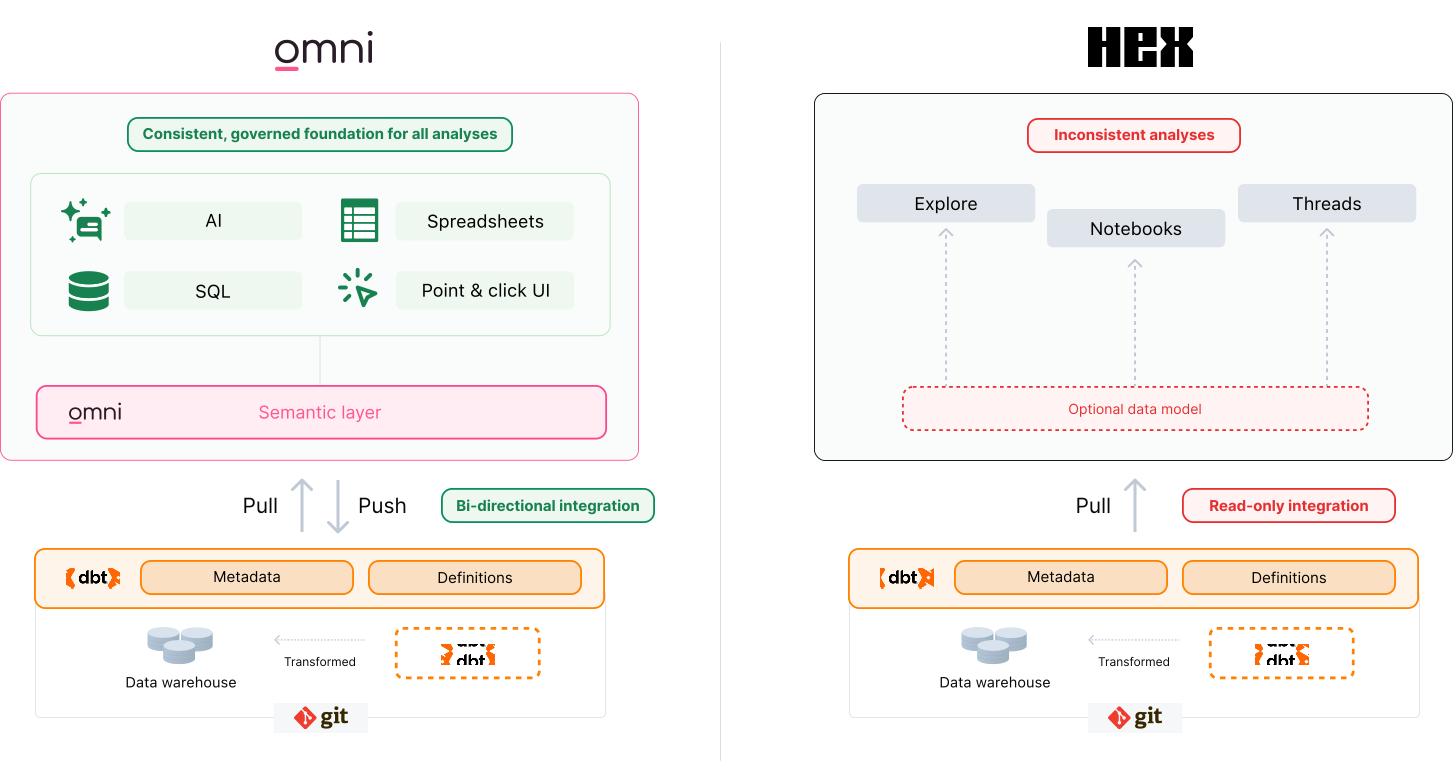
Two-way dbt integration keeps your BI layer and warehouse in lockstep. Push new metric definitions from Omni to dbt to make them universally accessible. Changes in dbt sync back without overwriting work done in Omni. The model evolves from both sides without drift.
Hex syncs from dbt Cloud (not dbt Core), but cannot push changes back. Analysts have to update logic in code outside the BI layer. This slows iteration and creates risk of definitions diverging between where they are authored and where they are consumed.
Omni's deep integration with dbt allows us to expose more of that context to our stakeholders right where they consume data…This also makes the analysts on my team happy because they don't need to have VS Code and Omni side-by-side as they're developing the data model.
– Priya Gupta, Head of Data at Cribl (read the case study)We looked at the questions people ask, like "How many tickets did Michael resolve last year?" Then we taught the AI how to interpret names, attributes, and domain-specific language. Omni's AI accuracy jumped overnight.- Taha Le Bras, Lead Analytics Engineer

Trained Omni's AI with business context to deliver accurate, trustworthy answers across the organization
Read case studyOmni treats your semantic model like a codebase.
Omni's built-in software development lifecycle workflows let you confidently test changes and track changes with full version history. Hex pulls dbt metadata into notebooks but does not offer branch-based development or built-in version control for models.
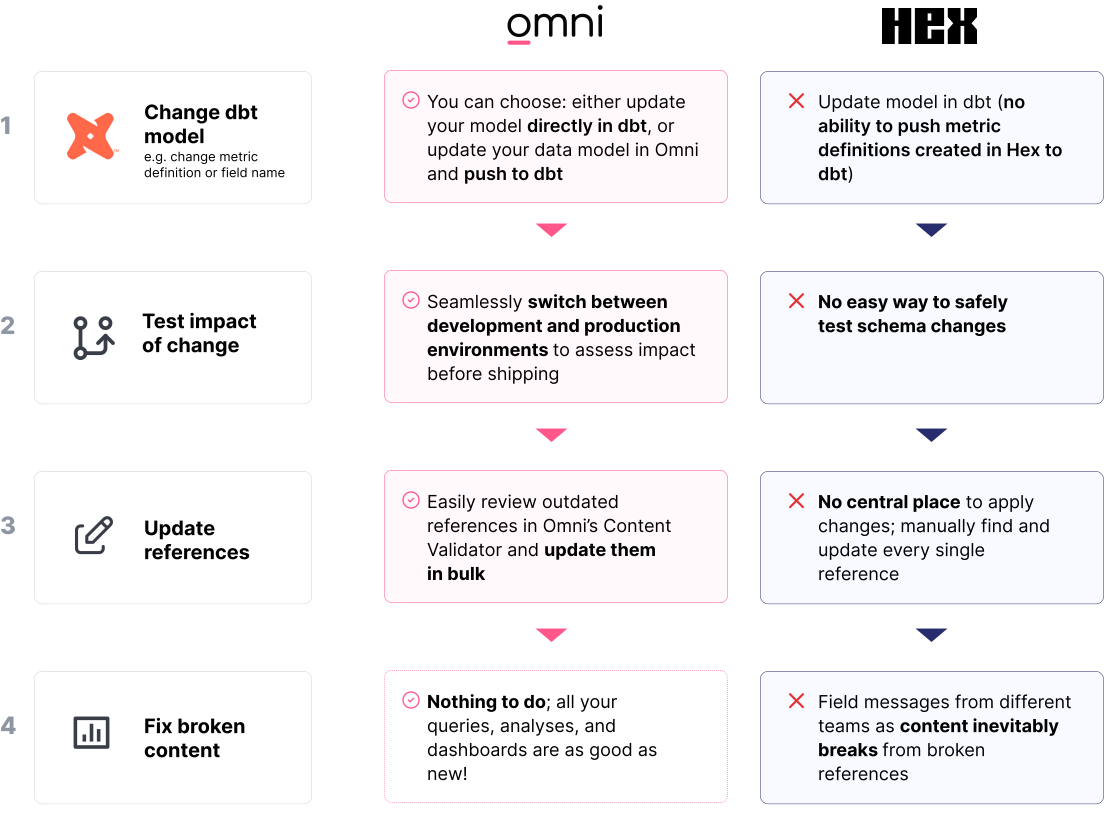
Omni's dynamic schemas let you switch between dev and prod in a click. Create a branch, point it at your dbt development schema, and test model changes against real content (dashboards, workbooks, and AI) before merging to production. Your end users never see incomplete work.
Hex has no equivalent to dev/prod environment switching in the BI layer. Analysts can query different schemas manually, but there is no integrated workflow for testing how upstream dbt changes affect downstream content before it goes live.
Branch mode gives every developer a safe sandbox. Create a branch of the entire data model (schema, content, and logic), test changes in isolation, review diffs, and merge when ready. It's Git-native version control applied to your BI layer.
Hex does not offer branching for its semantic layer or published content. Notebooks have version history, but there is no way to branch the full analytics environment, test changes holistically, and merge them back.
Omni's two-way integration with dbt has been a game changer. [...] Whether we are using our dbt models or building something fast in Omni, we can push the results back to our data warehouse with ease.
– Omni customerOmni's content validator catches broken references before users do. When a dbt model changes (renamed fields, dropped columns, updated logic), the content validator scans every dependent workbook and dashboard, surfaces what's affected, and lets you fix references in bulk.
In Hex, there is no automated way to find broken content after upstream changes. If a dbt model renames a column, you need to manually check every notebook and app that references it. At scale, this becomes a significant maintenance burden.
Omni integrates directly with Git for full version control of your data model. Track changes, review pull requests, roll back mistakes, and collaborate across your team using workflows you already know.
Hex syncs notebook projects to GitHub, with version history and optional PR workflows for publishing apps. But there is no Git-native version control for the semantic layer or data model itself.
As CTO, it's crucial to me that we can test changes before deploying to our customers. Omni was the first tool we saw that truly struck the right balance of giving our customers more flexibility, while keeping our team in control.
– Arsh Mand, CTO & Co-founder at WorkRamp (read the case study)Omni is built for teams that need governance at scale.
Governance determines whether your analytics scale safely or create risk. As AI agents access more data autonomously, security has to be structural. Omni builds row-level, column-level, and field-level security directly into the semantic layer. Hex does not.
Omni includes white-glove support for every customer. Customers get direct chat access to Omni's team, fast response times, and hands-on onboarding.
Hex's support tiers scale with pricing. Community and Professional plan users get standard support. Priority support and dedicated resources require Team or Enterprise plans.
Omni enforces row-level, column-level, and field-level security natively. Define access rules in the semantic layer so that every query — from a dashboard, workbook, AI chat, or embedded view — automatically respects user permissions. Security travels with the data, not the content.
Hex lacks native row-level or column-level security. Teams must rely on warehouse-level policies or build workarounds. Security does not extend consistently to notebooks, apps, or AI-generated results. Hex's security page and enterprise page confirm no native row-level or column-level security controls.
Omni supports SSO via SAML and OIDC, along with SCIM for automated user provisioning, group sync, and role management.
Hex supports SSO via OIDC only (SAML is not supported). SCIM is available on the Enterprise plan. Organizations using SAML-based identity providers will need workarounds.
Our permissions model is incredibly granular. Most tools couldn't even come close to supporting it. The Omni team rolled up their sleeves and helped us design something performant and secure.
– Thomas Stockham, Senior Product Manager, Data & AI at BambooHR (read the case study)Omni's drafting and publishing workflow gives data teams control over what goes live. Content moves through draft, review, and published stages — allowing teams to confidently test and validate changes before deploying to stakeholders.
Hex publishes notebooks as data apps, but there's no structured approval workflow for content changes. Updates to published apps go live immediately, without a formal review step.
Omni's embedded analytics carry the full governance model. Row-level security, column-level security, and user attributes all apply in embedded views. Your customers see exactly the data they're authorized to see, with the same reliability as internal dashboards.
Hex supports embedded data apps, but without native RLS or CLS, enforcing per-tenant data isolation in embedded contexts requires additional engineering work at the warehouse level.
We opened up Omni's full product suite to our customers. Now, they can create and save reports, build dashboards, schedule deliveries of data, and even use AI to ask questions in natural language. We're able to give them a whole new level of self-service without needing to compromise on the control we had with our homegrown solution.
– Arsh Mand, CTO & Co-founder at WorkRamp (read the case study)[...] We have also explored Hex's embedded analytics offerings but found that it's not quite mature enough for our requirements. Hex's embedded analytics bills per API call instead of per unique user, which is very expensive based on our setup where a user may need to access many different reports, and most other embedded analytics vendors are billing per distinct user per month. Also, the permissions and sharing controls are not as mature.
– Hex customerIf you like dbt, you'll love Omni's dbt integration
Omni's dbt integration supports real analyst workflows: switching between dev and prod schemas, creating dbt models from logic built in Omni, and more.
Hex's integration is read-only. You can ingest metadata and metrics, but logic from Hex can't be pushed down to dbt natively. If business users are creating new metrics or adding AI context, that gets siloed within Hex.
See how Omni's dbt integration compares to Hex's
FAQs
We want governed AI that business users can trust. Which tool is a better fit?
Both Omni and Hex have AI features designed to help business users get answers without waiting on the data team. The difference is in the foundation those answers are built on.
Hex's AI generates SQL and Python on the fly. It can reference a semantic model if one exists, but the AI isn't required to go through it. When an answer looks off, non-technical users have no governed model to trace it back to.
Omni's AI queries your semantic layer — the same governed metrics, joins, and business logic behind your dashboards. Every answer is consistent and auditable from the UI. Business users can inspect the underlying query, drill into fields, and trust the results.
Our team has both notebook-loving analysts and spreadsheet-first business users. Can one tool serve both?
Hex started as a notebook platform. Analysts and data scientists are comfortable there, and recent additions (Threads, the Explore UI, Magic AI) have extended it toward self-service. But the underlying experience is still code-first. Business users who live in spreadsheets often hit a ceiling and route work back to the data team.
Omni was built for both audiences from the start. Analysts get SQL, a modeling IDE, Git integration, and dbt workflows. Business users get dashboards, cross-filtering, drill-throughs, spreadsheets with Excel formulas, and an AI agent — all grounded in the same semantic layer. Everyone works in the same workbook without handoffs.
We're heavily invested in dbt. How do Omni and Hex integrate?
Hex can sync models and metrics from dbt Cloud (not dbt Core), but the integration is one-way. Changes made in Hex don't push back into dbt, which means analysts often edit logic outside the BI layer to keep things in sync.
Omni's dbt integration is two-way. You can push metrics developed in Omni back to dbt to make them universally accessible, and dynamic schemas let you switch between dev and prod environments in a click to test changes safely. Omni works with both dbt Cloud and dbt Core.
Does Hex have the governance controls we need to scale BI beyond the data team?
Hex covers the basics — SSO, SCIM, permissioned projects — but lacks native row-level or column-level security in the BI layer. Access control relies on warehouse permissions or manual workarounds, which creates governance gaps as more users and sensitive data enter the platform.
Omni has row and column-level security defined natively in the semantic layer, content approval workflows with drafts and reviews, user attributes for personalized access, and embedded analytics with full multi-tenant governance. These controls apply consistently across dashboards, workbooks, AI, and the API.
How do Omni and Hex handle change management for the semantic layer?
Hex syncs notebook projects to GitHub and has version history, with optional PR workflows for publishing apps. But there's no Git-native version control for the semantic layer itself, and no branching of the full analytics environment.
Omni treats the semantic model like a codebase. Branch mode gives every developer a safe sandbox to test changes against real content, Git integration provides full version control, and the content validator surfaces broken references before users see them. You develop analytics the way you ship code.
Our team wants to use AI to reduce ad-hoc requests to the data team. Which tool should we choose?
Omni's AI is built on the same semantic layer that powers your dashboards — so every AI answer uses governed metric definitions, joins, and access controls your team already maintains. Business users can ask questions in natural language, get verifiable answers, and then keep going: switching to spreadsheets, SQL, or point-and-click without leaving the workbook. Row-level security applies to AI results automatically, so users only see data they're authorized to see. And AI is included for every Omni customer — no premium tier required.
The result is fewer ad-hoc requests, because users can self-serve confidently. When AI answers a question, the user is not stuck — they can pivot, filter, drill down, or build on the result using familiar tools. That's what actually deflects requests from the data team: not just answering the first question, but enabling the follow-up.
Hex's AI generates and executes SQL and Python code, with reliability guided by endorsed tables, workspace rules, and context docs. Threads (conversational AI for non-technical users) is only available on Team and Enterprise plans, and AI compute is billed on top of seat costs. Users can ask follow-up questions or open results in the Explore UI, but there's no spreadsheet with Excel-style formulas and no unified workbook where AI results and manual analysis coexist. When follow-up goes beyond what the agent produces, it routes back to the data team.
Our team uses dbt extensively. Which tool integrates better?
Omni's two-way dbt integration lets you push metric definitions from Omni back to dbt, keeping your BI layer and warehouse in lockstep. Dynamic schemas let you switch between dbt dev and prod environments to safely test how model changes affect dashboards and AI before anything goes live. Branch mode gives every developer an isolated sandbox of the full analytics environment. And the content validator automatically catches any workbooks or dashboards broken by upstream dbt changes — so you do not have to find out from your users. Omni integrates with both dbt Core and dbt Cloud.
Hex pulls metadata from dbt Cloud and integrates with the dbt Semantic Layer. This is useful for surfacing context and querying governed metrics inside notebooks. But Hex cannot push changes back to dbt, does not offer dev/prod environment switching for the BI layer, and has no content validation tooling for catching breakage after upstream changes. Hex's dbt metadata integration also requires dbt Cloud, but dbt Core users do not get the same depth of integration.
Why do I need Omni's semantic layer if I already use dbt? Business logic should live in the warehouse.
dbt is excellent for defining core data models that need to be versioned, tested, and reused across products. But not every use case fits cleanly into a dbt deploy cycle. In practice, business teams constantly need new metrics, quick calculations, or ad-hoc slices to answer time-sensitive questions. When every change requires a dbt update and deployment, the data team becomes a bottleneck and iteration slows down.
Omni's semantic layer is complementary to dbt, not a replacement. It lets analysts define reusable logic and combine it at query time — period-over-period comparisons, ratios, filtered aggregations — without waiting on a dbt deploy. When an ad-hoc metric proves valuable, it can be promoted to Omni's shared model or pushed back to dbt so it's universally accessible. This flexibility is what makes just-in-time modeling practical. The semantic layer evolves through everyday work, not just top-down mandates.
Omni's semantic layer also creates the foundation for trustworthy AI. You can add descriptions, AI context, synonyms, and field-level instructions that inform how Blobby interprets questions — all of which can draw on metadata already defined in dbt. Without a BI-layer semantic model, AI tools are left generating raw SQL against your warehouse schema, with no governed abstraction to keep answers consistent.
Hex integrates with the dbt Semantic Layer via MetricFlow and can sync models from dbt, Snowflake, or Cube. This gives Hex users access to governed metrics inside notebooks. But Hex's own semantic layer is newer and more limited in depth — it lacks support for extensions, aggregate awareness, user attribute integration, and complex join topologies that teams need at scale. And because Hex cannot push logic back to dbt, insights built in Hex stay in Hex unless your team manually ports them.
We need governed self-service for business users AND flexibility for our data team. Do we need two tools?
With Omni, no. Business users get AI chat, spreadsheets with live data, Excel-style formulas, point-and-click exploration, and governed dashboards. Technical users get SQL, a model IDE with Git integration, API access, and an MCP server for using Omni's AI in any external tool. Everyone works on the same semantic layer, so metrics are consistent regardless of how someone accesses the data. When a business user builds something useful during exploration, they can promote it to the shared model — so the governed foundation grows through everyday work. And you can build beautiful custom charts directly in Omni with Markdown visualizations and CSS dashboard controls, or let AI build them for you.
Hex is built for technical users first. Notebooks are excellent for data scientists and analysts who write SQL, Python, and R. Threads provides a conversational AI interface for non-technical users, but once those users want spreadsheet formulas, governed shared metrics, or a unified workbook alongside dashboards, there's no path forward without the data team. In practice, many Hex customers still need a separate BI tool for their business users, which fragments metrics and governance across two platforms.
We want to embed analytics into our product for customers. How do Omni and Hex compare?
Omni's embedded analytics carry the full governance model into your product. Row-level security, column-level security, and user attributes all apply in embedded views — so each customer sees exactly the data they're authorized to see, with the same reliability as your internal dashboards. Customization options, including Markdown visualizations, CSS dashboard controls, and white-labeling, let you match your product's brand and deliver a consistent experience.
Hex supports embedding data apps, and they work well for exposing interactive analyses to external users. But Hex lacks native row-level and column-level security, so enforcing per-tenant data isolation in embedded contexts requires additional engineering work at the warehouse level. If your embedded analytics use case requires strict data segmentation across customers — which most do — Omni's native governance removes significant implementation and maintenance overhead.
We have a small data team supporting hundreds of business users. Which tool reduces our maintenance burden?
Omni is designed to free up data team bandwidth. The shared semantic layer ensures consistent metrics across every user and workflow — so your team fields fewer questions about conflicting numbers. Just-in-time modeling lets business users contribute to the model during their analysis, reducing the backlog of "can you add this metric" requests. The content validator catches broken content after upstream changes, so your team is not manually auditing dashboards after every dbt deploy. Omni's intelligent caching delivers fast, fresh results without running every query live — keeping your warehouse costs under control as usage scales. And because AI, dashboards, spreadsheets, and SQL all run on the same governed model, there's only one central system to maintain.
In Hex, the data team is more central to everyday workflows. Notebooks are powerful for analysts, but non-technical users depend on Threads for AI answers and on the data team for anything beyond simple questions. There's no content validator to catch breakage after schema changes, no just-in-time modeling path for business users, and no built-in spreadsheet interface for users who think in rows and formulas. For small teams supporting large organizations, this translates to more ad-hoc requests, more manual maintenance, and less predictable costs. Hex also lacks an intelligent caching layer, meaning most queries hit the warehouse directly — which can increase compute costs as usage grows.